In early April 2026, Tsinghua University NexGen Global Forum and the Financial University under the Government of the Russian Federation jointly convened two thematic roundtable meetings on the ongoing Iran crisis and the geopolitical situation in the Middle East, bringing together scholars, faculty, and students from both universities. Dr. Igor A. Matveev, Associate Professor at the Department of International Business of the Financial University, served as the keynote speaker at both events. Drawing on his extensive experience in diplomatic and international affairs research, he offered a systematic analysis of the strategic logic of the Iran crisis, its spillover effects, and Iran's capacity to withstand external military pressure.
I. First Roundtable: Iran Crisis Analysis
On April 2, 2026, the Tsinghua NexGen Global Forum hosted a thematic roundtable exchange under the title "Iran Crisis Analysis." The discussion focused on the strategic interplay among major powers in the Middle East against the backdrop of the Iran crisis, the political and economic logic of international conflict, and the space for China-Russia cooperation on regional and global governance issues. Scholars, faculty, and student representatives from the Financial University under the Government of the Russian Federation joined Tsinghua participants in the exchange.
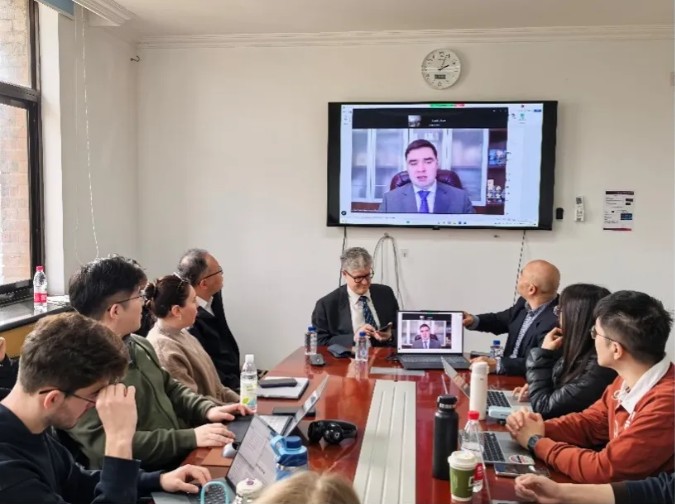
In his remarks, Dr. Matveev analyzed the strategic logic underlying developments in the Middle East through the lens of the interest structures of key actors—the United States, Israel, Russia, Iran, and China. He noted that Washington's core concerns in the region include sustaining long-term support for Israel, maintaining a military presence in the Persian Gulf, countering China's growing influence in the Middle East, and constraining the expansion of Iran's nuclear capabilities and regional reach through policy instruments such as "deterrence by denial." Israel, meanwhile, places greater emphasis on consolidating its regional security dominance and on leveraging external security issues to sustain domestic political cohesion.
On Russia's strategic positioning in the Middle East, Dr. Matveev observed that the Ukraine question remains the "priority variable" in Russian foreign policy, and that Russia's Middle East policy serves, to a certain extent, its broader strategic competition with the United States. Against this backdrop, Russia seeks to extract energy, financial, and geopolitical gains from regional developments, while simultaneously maintaining parallel channels of communication with Israel, Iran, Türkiye, and the Gulf states, and working to preserve its presence in Syria as well as its function as a geopolitical pivot extending into Africa.
On the strategic calculations of Iran and China, Dr. Matveev observed that Iran's objectives in the crisis center on using asymmetric means to strengthen its bargaining position vis-à-vis the United States and on securing greater economic and strategic leverage over critical chokepoints such as the Strait of Hormuz. China, in contrast, is more focused on the crisis's impact on energy supplies, logistics, and regional economic cooperation, opposes nuclear proliferation and the uncontrolled spread of weapons of mass destruction, and places high value on safeguarding overall regional stability through multilateral mechanisms. He argued that the Iran crisis opens practical space for China-Russia cooperation in advancing multipolarity, strengthening coordination under the UN framework, and expanding energy and institutional cooperation, though such cooperation is also constrained by China-U.S. economic interdependence, Russia's strategic focus on Ukraine, and potential competition between the two in parts of the Global South.
During the interactive discussion, participants raised a range of topical questions, including the reasons behind shifts in the U.S. position on the transfer of Iran's enriched uranium, whether Russia could serve as a technical guarantor of the safety of Iran's nuclear facilities, China's stance on related matters at the UN Security Council, the role of the BRICS mechanism in Russia's overall strategy, and security arrangements involving Syria, NATO, and the Gulf states. Dr. Matveev addressed these questions in light of the current international situation, emphasizing that they are highly complex and shaped both by great-power strategic relations and by the security preferences and practical interests of regional states.
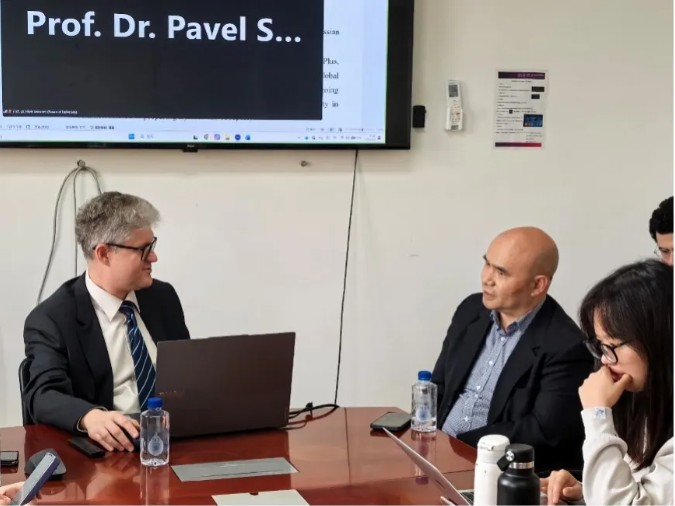
II. Second Roundtable: Iran's Limits of Endurance under External Military Action
On the afternoon of April 9, 2026, the roundtable "Iran's Limits of Endurance under External Military Action: Internal Potential, the 'Axis of Resistance,' Allies, and Partners" was successfully held. The meeting brought together scholars from Tsinghua University and the Financial University under the Government of the Russian Federation to examine the latest developments in Middle East geopolitics. The session was chaired by Dr. Yang Guang, Assistant Professor at the Institute for International and Area Studies of Tsinghua University, while Dr. Maria I. Volkhonova, Deputy Dean of the Faculty of International Economic Relations at the Financial University, delivered the welcome address.
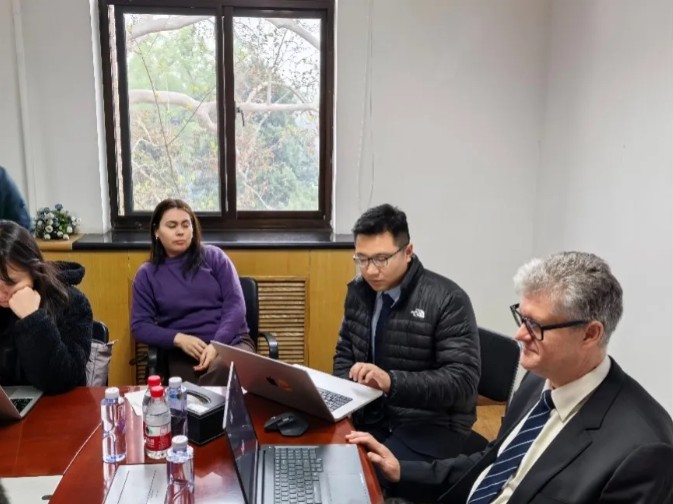
Dr. Matveev once again delivered the keynote address, assessing the logic of Iran's survival under extreme external pressure from multiple perspectives. He noted that Iran, with a territory of roughly 1.65 million square kilometers, benefits from mountainous terrain and a favorable strategic location that render large-scale ground operations difficult. At the same time, Iran can leverage its geographic proximity to blockade the Strait of Hormuz and mount effective countermeasures. He further argued that external conflict tends to mobilize rather than fracture Iranian society: the Iranian public's strong sense of "national heroism" and willingness to sacrifice serve as a critical underpinning of Iran's "pressure-resistant economy." In addition, Iran is able to project regional influence through its "axis of resilience."
Dr. Ivan Starodubtsev, Associate Professor at the Department of International Business of the Financial University, focused his remarks on Türkiye's posture amid the current conflict. He noted that Türkiye's overseas diplomatic missions have expanded from 163 in 2002 to 253 in 2024, making it the third-largest diplomatic network in the world, while its foreign policy slogan has evolved from "good neighborliness" to the more assertive "360-degree diplomacy." The current conflict poses serious challenges for Türkiye, including the risk of economic crisis, a refugee crisis, and direct entanglement in hostilities; some Turkish observers even suggest that, after the Strait of Hormuz, the Dardanelles could also come under threat. Against this backdrop, Türkiye has adopted a more neutral stance, with Foreign Minister Hakan Fidan emphasizing that Ankara opposes both Israel's military actions and any Iranian moves to widen the conflict.
During the Q&A session, participating experts and students exchanged views on the potential for nuclear escalation in the current conflict and its implications for countries such as Russia and China. At the close of the meeting, students took a group photo with keynote speaker Dr. Matveev.
By combining the analysis of pressing international issues with the building of academic cooperation mechanisms, the two roundtables deepened participants' understanding of the Iran crisis and the political economy of international conflict, while providing a new platform for exchange between Chinese and Russian universities in the fields of international relations, area studies, and global governance. Looking ahead, the two sides plan to continue convening thematic discussions on the Middle East, BRICS cooperation, international security, and regional governance, further advancing substantive transnational academic dialogue.

