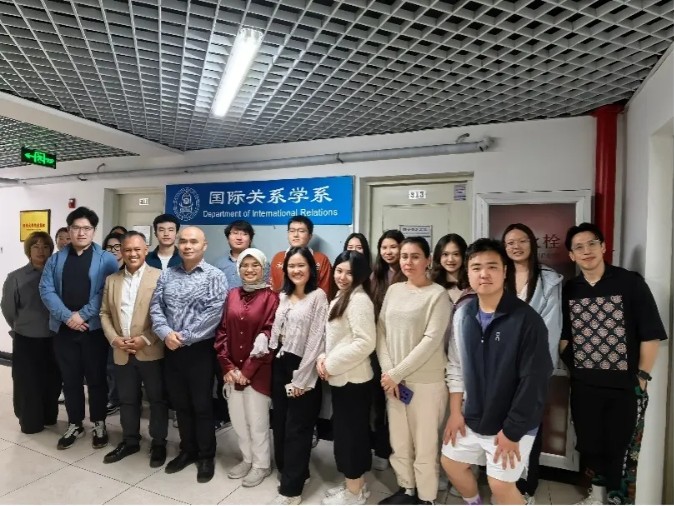
On April 16, 2026, the NexGen Global Forum at Tsinghua University held a roundtable discussion on “Evolving Philippines-China Relations and Bilateral Consultation Mechanism.”
Centered on the recent China-Philippines Bilateral Consultation Mechanism (BCM) meeting, the event featured in-depth discussions on the long history of bilateral exchanges between China and the Philippines, the current state of China-Philippines relations and territorial disputes, the role of the BCM in easing tensions in the South China Sea, the scope for cooperation between the two countries across multiple functional areas, and the prospects for future strategic interaction between the two sides against a complex backdrop.
The keynote speaker was Dr. Rommel Banlaoi, a prominent Filipino political scientist, international security scholar, and China studies expert, who serves as Director of the Philippine Center for Chinese Studies and is a former President of the Philippine Association for Chinese Studies (PACS). Dr. Banlaoi is currently President of the Philippine Society for International Security Studies (PSISS) and has been honored with the “Award for Outstanding Contribution to Promoting Philippines-China Understanding.” He has long been dedicated to advancing Philippines-China dialogue and cooperation and to the peaceful resolution of South China Sea disputes.
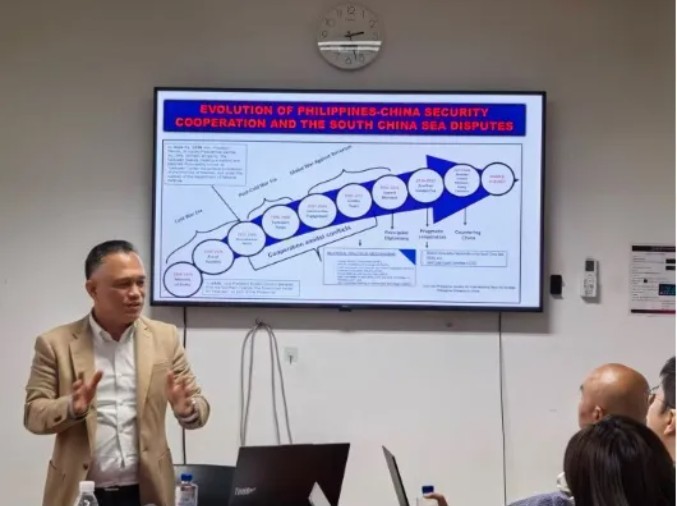
Drawing on his deep expertise in Philippines-China relations, Dr. Banlaoi began by systematically reviewing the history of bilateral ties and the current state of the relationship. He noted that as early as the pre-colonial era, ancient Chinese civilization engaged in active trade and cultural exchanges with various Philippine kingdoms. He emphasized that the South China Sea has historically served as a bridge rather than a barrier between the two countries, with trade records with the Philippines preserved throughout the Tang, Song, and Ming dynasties, and with the Butuan Kingdom having dispatched envoys to China during the Song Dynasty. China and its well-preserved historical records have become an important part of the Philippines’ present-day identity. However, due to the legacy of the colonial period and anti-communist movements during the Cold War, Philippine society inherited derogatory views of China, which became one of the roots of today’s “anti-China, Sinophobic” sentiment.
At the same time, turning to the current state of Philippines-China relations, Dr. Banlaoi observed that the Philippines is caught at a balancing point between security skepticism and economic necessity. While the Philippines has practical needs for engagement with China against the backdrop of challenges such as the energy crisis, its security establishment remains strongly suspicious of China under the influence of the U.S.-Philippines alliance (for example, the 2024 expansion of the EDCA agreement). Nevertheless, the recent BCM meeting effectively eased tensions in the South China Sea by reopening diplomatic channels and emphasizing dialogue over confrontation. Both sides reaffirmed their commitment to peacefully managing disputes and actively explored cooperation opportunities in functional areas such as fisheries, energy, and scientific research, creating a more strategically meaningful and pragmatic space for bilateral interaction.
Dr. Banlaoi then further examined the potential for pragmatic cooperation between China and the Philippines. He pointed out that although sovereignty disputes have yet to be fully resolved, both sides can actively explore opportunities for cooperation in fields such as fisheries, energy, and scientific research. The BCM mechanism provides the two parties with a more strategically meaningful space for engagement: the Philippines can assert its sovereignty claims through diplomatic means, while Beijing can demonstrate its willingness to cooperate through the same mechanism. This pattern of engagement signals that, while cautious, bilateral relations between the two countries have already achieved notable improvement.
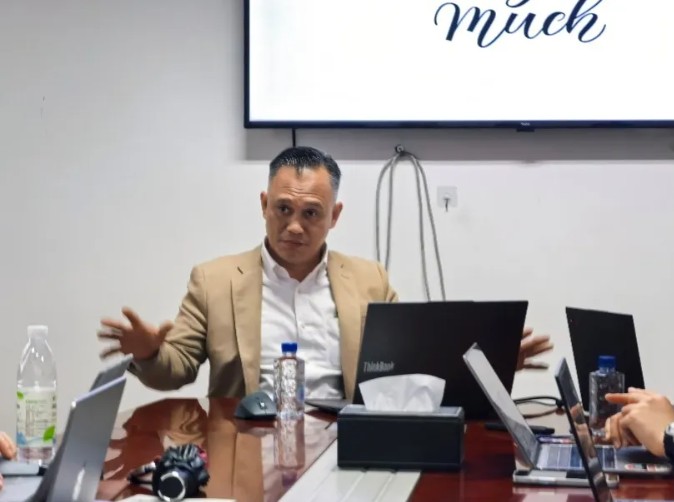
Looking ahead to the trajectory of the relationship, Dr. Banlaoi argued that the BCM serves as an important diplomatic tool whose core value lies in combining conflict management with functional cooperation, allowing both sides to maximize shared interests even while differences persist. The cultivation of such “strategic space” helps the two countries find a point of balance within a complex regional geopolitical environment and steers bilateral relations toward a more resilient trajectory.
Finally, during the interactive discussion, Dr. Banlaoi provided in-depth responses to hot-button issues such as the U.S.-Philippines alliance, great-power rivalry, and crisis management. He analyzed the influence of Philippine domestic politics on foreign policy and noted that allies’ doubts about U.S. leadership have prompted the Philippines to seek a reset in its relationship with China. He also observed the rise of Chinese soft power—such as brands and pop culture—among the younger generation of Filipinos. Dr. Banlaoi concluded that the future of Philippines-China relations will be characterized by the coexistence of competition and cooperation; the Philippines should learn from Thailand’s art of balancing, overcome excessive dependence on any single great power, and, through cooperative mechanisms such as the BCM, seek to maximize shared interests within conflict management.
By combining cutting-edge analysis of international security dynamics with Dr. Banlaoi’s scholarly depth, the event deepened participants’ understanding of the complexity of Philippines-China relations and offered a valuable expert perspective for advancing regional security and peaceful development.